
Features
LivingMemory is not just a chat log. It transforms conversations into searchable, decay-aware long-term memories that agents can also use directly.
Automatic reflection
After the configured number of rounds, the plugin asks the LLM to summarize recent conversation into structured memory.
Rich retrieval content
Retrieval content is assembled from summary + key_facts to preserve information density. persona_summary powers memory injection, dashboard display, and persona expression.
Agent memory tools
Agents can call recall_long_term_memory to search old memory or memorize_long_term_memory to store durable facts.
Memory atomization
Important facts become independent atoms with type, TTL, importance, access count, and decay state.
Where memories come from
| Path | Trigger | Best for |
|---|---|---|
| Automatic reflection | Conversation reaches the configured summary rounds | Long-term preferences, project context, relationships, durable facts |
| Agent write tool | The model calls memorize_long_term_memory | Explicit "remember this" requests, important agreements, long-running tasks |
| Manual administrator summary | /lmem summarize [message_count] | Save the current context immediately or re-summarize the latest N messages |
Summarization produces a persona-styled summary used for both memory injection and dashboard display (persona_summary), while retrieval content is assembled by code from summary and key_facts so a single compressed summary cannot drain information density. Custom prompts may still emit a factual canonical_summary for consumers such as graph extraction. Memories above the source-retention threshold also store their source messages separately in SQLite. Those messages are not indexed for normal recall, but remain available for Dashboard review, re-summarization, and deep source retrieval by the Agent recall tool.
How recall works
Before the LLM request is sent, LivingMemory retrieves relevant memories. Results can be appended to the user message, placed before or after it, or injected as simulated tool-call context.
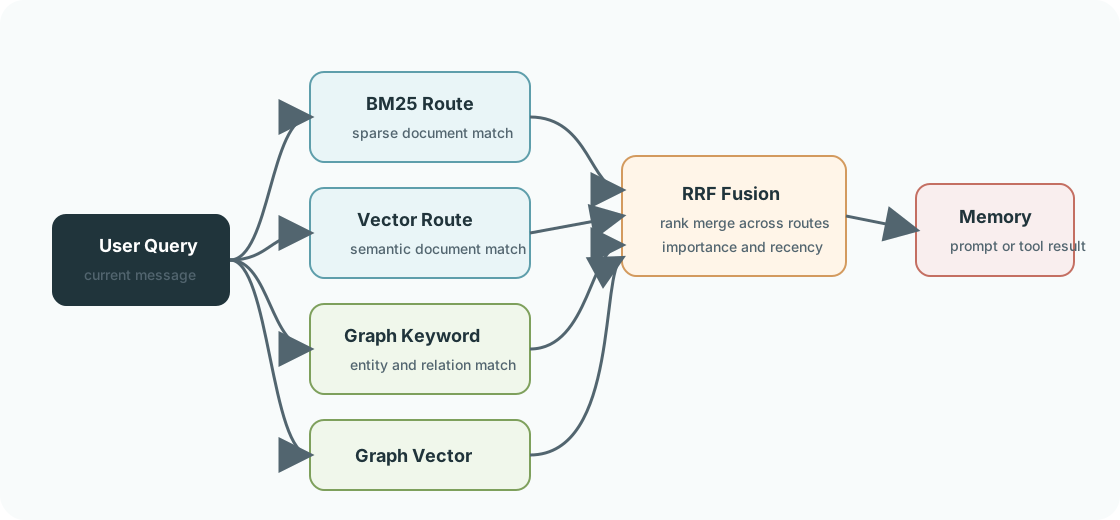
Ranking combines:
| Factor | What it does |
|---|---|
| Keyword match | BM25 and graph keyword retrieval quickly find concrete entities and phrases |
| Semantic similarity | Vector retrieval handles different wording with similar meaning |
| Graph relationships | Entities and cross-memory edges add structure across facts |
| Importance | Durable preferences and agreements are favored |
| Time decay | Old memories gradually lose weight unless repeatedly accessed or reinforced |
| Retrieval boundaries | Candidates can be filtered by minimum importance, vector similarity, and memory type |
| Recent-memory reserve | Dedicated slots keep recent in-scope memories from being displaced by similarity ranking alone |
| Recent context | Recall can include recent conversation within a configured age limit to reduce topic drift |
Opt-in agentic recall (beta)
agent_tools.enable_agentic_recall_beta (off by default; requires agent_tools.enable_recall_tool) extends active recall into a multi-turn loop within one request:
| Capability | Behavior |
|---|---|
| People-centric search | target="current_speaker" searches the current speaker's experiences; start_time/end_time filter by event time; exclude_ids and search_offset support cursored paging |
| Evidence reading | read_memory_evidence returns a memory's active facts and, when the whole source is verifiably visible to the session, its retained text; facts and source are cursor-addressable so a truncated read resumes exactly |
| Shared budget | Tool calls, cumulative tool time and per-call output share one per-request budget; when it is spent the model answers from the evidence it already gathered |
| Add-only rules | The recall rule prompt is injected as a temporary part, never into conversation history or the plugin's message store |
With the switch off, tool registration, retrieval and prompts are identical to the default behavior.
Who can access which memories?
The same boundaries apply to both memory writes and recall:
| Capability | Behavior |
|---|---|
| Memory scopes | session isolates each conversation, user shares across private and group chats for one platform user, global shares broadly, and legacy preserves earlier behavior |
| Forced isolation | Selected conversations always keep an independent scope, even when a shared mode is active |
| Memory allowlist | Limits capture, summarization, recall, and Agent memory tools to selected users, groups, or complete session IDs |
| Identity aliases | Maps platform identities to stable names before summarization; graph participants also reuse stable identities instead of splitting on nickname changes |
Scope changes affect newly written memories only. Existing data is not migrated automatically.
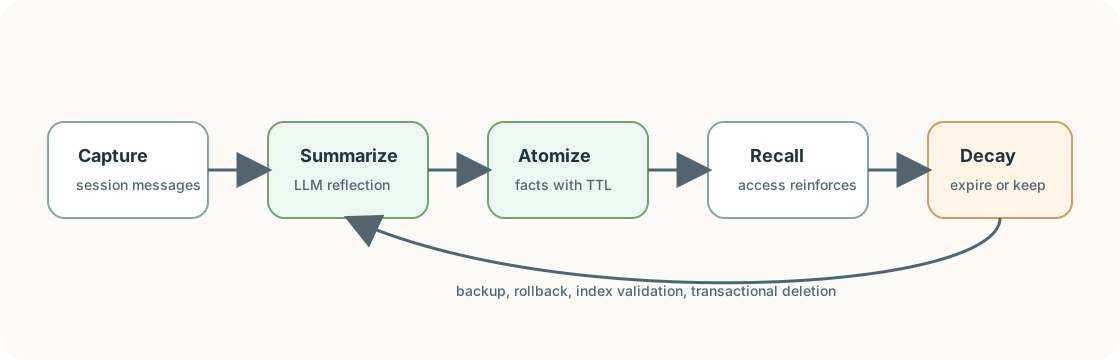
Lifecycle behavior
| Mechanism | Purpose |
|---|---|
| Importance decay | Reduces the weight of old low-value memories |
| Access reinforcement | Frequently recalled memories are more likely to stay relevant |
| Atom TTL | Different fact types can age differently |
| Cleanup or archiving | Low-value memory can be deleted permanently or removed from recall indexes while retained as a recoverable archive |
| Important-memory protection | Memories above a configured threshold are excluded from daily importance decay |
| Source retention | High-importance memories can retain source messages for audit and re-summarization |
| Safe backups | Creates backups before version updates and migrations |
Archived memories do not participate in normal recall. Restoring one from the Dashboard regenerates its embedding and rebuilds BM25, graph, atom, and other derived indexes.
How large index maintenance stays available
After startup, LivingMemory checks document, vector, BM25, and graph indexes in the background instead of blocking plugin readiness when extensive repairs are required:
| Mechanism | Purpose |
|---|---|
| Provider fingerprint | A changed embedding provider or model triggers a full vector generation rebuild, even when dimensions are unchanged |
| Batching and checkpoints | Read size, embedding batches, concurrency, and delays are bounded; full vector rebuilds can continue from checkpoints |
| Shadow indexes | BM25, FAISS, and graph data are built in a separate generation and switched only after success; failures leave the live generation intact |
| Concurrent-write reconciliation | A final consistency pass repairs data written or changed while maintenance was running |
| Visible status | /lmem status reports checking, rebuilding, partial, failed, and cancelled states with progress |
See WebUI management for data operations and Configuration for all related settings.