
Architecture
LivingMemory is built from event hooks, memory processing, retrieval fusion, storage, and a Pages API. Automatic memory and active agent tools share the same core data model so they do not become two separate memory systems.
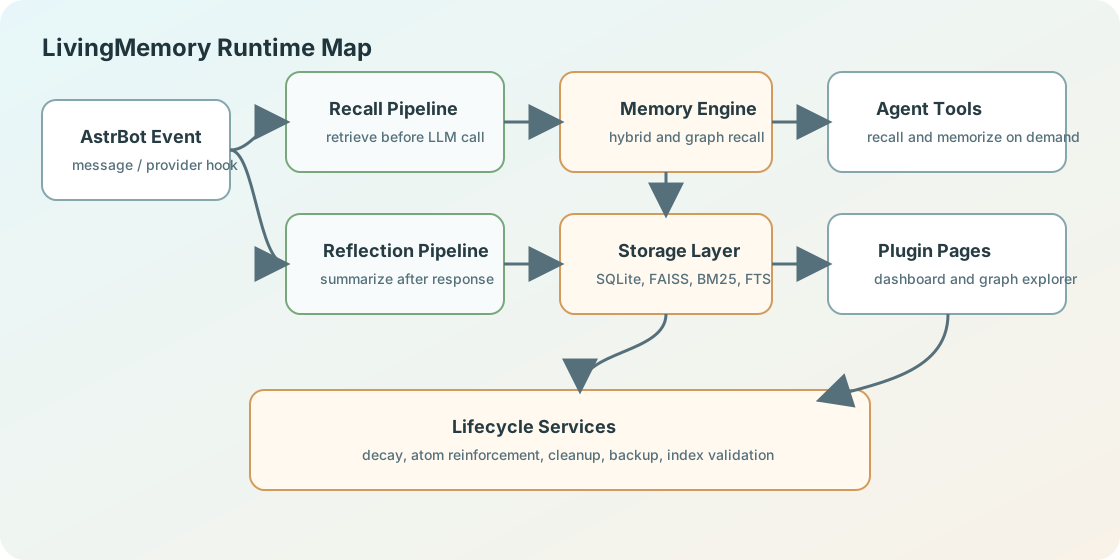
Runtime flow
- AstrBot receives a message and
EventHandlercaptures session context. - Before the LLM request, the recall pipeline searches long-term memory using the current message and optional recent context.
- Retrieved memories are injected into the request or returned as agent tool results.
- After the LLM responds, the reflection pipeline decides whether to summarize and store new memory.
- Background tasks handle decay, cleanup, backup, and index validation.
Main modules
| Module | Responsibility |
|---|---|
main.py | Registers the plugin, initializes runtime components, registers agent tools and Pages API |
core/plugin_initializer.py | Non-blocking initialization, provider waiting, database migration, index loading |
core/event_handler.py | Group capture, memory recall, memory reflection |
core/managers/memory_engine.py | Unified write, search, delete, and index maintenance |
core/managers/graph_memory_manager.py | Coordinates graph nodes, edges, entries, and graph retrieval |
core/managers/atom_lifecycle_manager.py | Maintains atom expiration, forgetting, reinforcement, and lifecycle state |
core/retrieval/ | BM25, vector, graph, atom retrieval, and RRF fusion |
storage/ | SQLite storage, graph storage, atom storage, database migration |
pages/dashboard/ | AstrBot Pages management UI |
Dual-route retrieval
Document memories and graph memories are searched through two routes:
| Route | Keyword mode | Vector mode |
|---|---|---|
| Document route | BM25Retriever | VectorRetriever |
| Graph route | GraphKeywordRetriever | GraphVectorRetriever |
RRFFusion merges the ranked lists, then the runtime applies importance, time decay, session filtering, and persona filtering.
Memory data model
| Type | Description |
|---|---|
| Session messages | Raw conversation context used for summarization triggers and expanded queries |
| Memory entries | LLM-generated long-term memories with summaries, importance, session, and persona metadata |
| Graph nodes and edges | Entities and relationships extracted from memories, with cross-memory merging |
| Memory atoms | Independent fact units with type, TTL, decay, and access reinforcement |
Data safety
| Scenario | Protection |
|---|---|
| Plugin version change | Startup creates a version-tagged backup |
| Database migration | Backup before migration |
| Index rebuild | Batched rebuild with rollback on failure |
| Memory deletion | Transactional deletion of related records |
| Dashboard operations | Pages API reuses MemoryEngine and GraphStore instead of bypassing backend safety logic |